
Model Configuration trains regression models that power budget predictions in EnerG. In the building view, expand Budget in the left sidebar and open Model Configuration. Link trained models to budgets in Budget planning through the Model field in Basic Setup. For how budget models produce predicted values, see Budgets and capital planning. For portfolio rollups, see Portfolio budget and planning. For variance against an active plan, see Building budget overview.
Models need enough historical usage and weather data in the reference period. Confirm meter completeness on Building meters before you train.

Open Model Configuration

1

Select a building

From Portfolio Home, open a building in the building view.
2

Open Model Configuration

In the left sidebar, expand Budget, then click Model Configuration.

Manage configurations

The Model Configuration page lists prediction models for the building. Click + Create Configuration to start the five-step wizard. Click a Name to open the summary drawer, or use Actions to edit or delete a row.
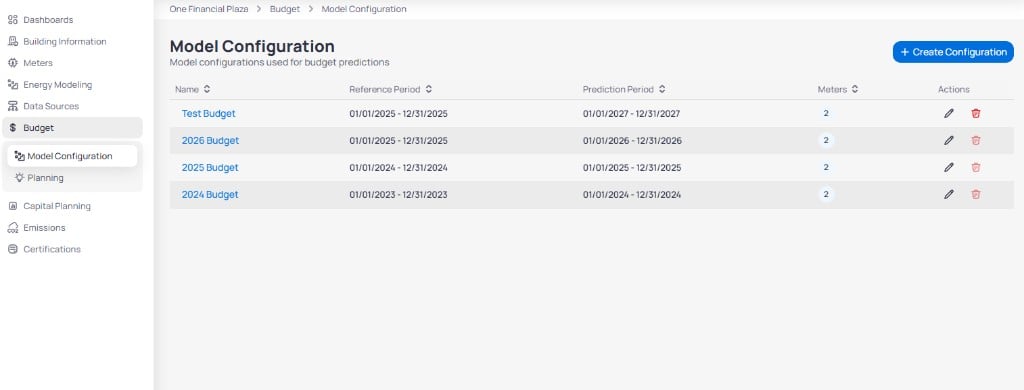
Model Configuration page for One Financial Plaza showing table with Name Test Budget 2026 Budget 2025 Budget 2024 Budget Reference Period and Prediction Period date ranges Meters count 2 and edit delete actions plus Create Configuration button

Model Configuration list with reference and prediction periods

Review the summary drawer

Click a configuration Name to open Summary without entering the wizard.
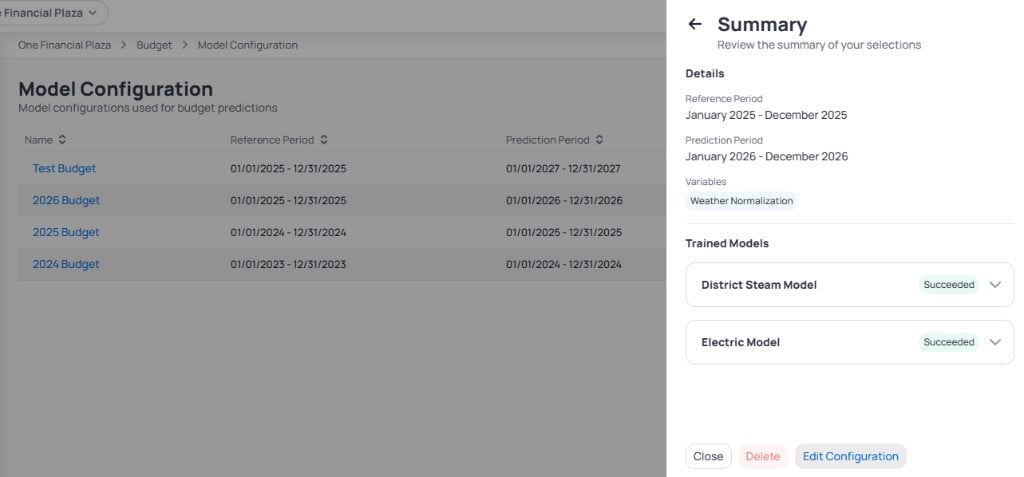
Summary drawer showing Reference Period January 2025 through December 2025 Prediction Period January 2026 through December 2026 Variables Weather Normalization tag and District Steam Model and Electric Model Succeeded badges with Close Delete and Edit Configuration buttons

Model Configuration Summary drawer with trained models

Click Edit Configuration to change settings or Delete to remove the model.

Create a model configuration

Click + Create Configuration to open the wizard. Progress appears in the left sidebar across five steps: Basic Setup, Historical Usage, Historical Weather, Variables, and Summary.

Step 1: Basic setup

Define the model name, prediction period, and meters by service type.
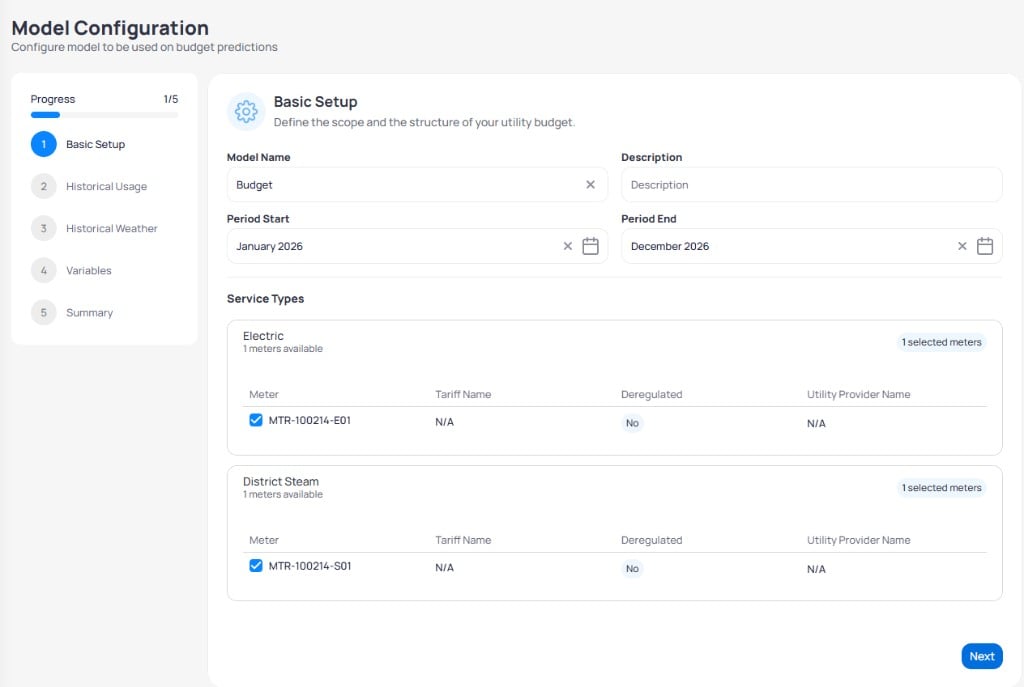
Model Configuration wizard step 1 of 5 Basic Setup with Model Name Budget Period Start January 2026 End December 2026 Electric meter MTR-100214-E01 and District Steam meter MTR-100214-S01 selected in tables

Model Configuration wizard step 1 Basic Setup with meter selection

Click Next to continue.

Step 2: Historical usage

Choose a reference year and review usage or cost trends that inform the model.
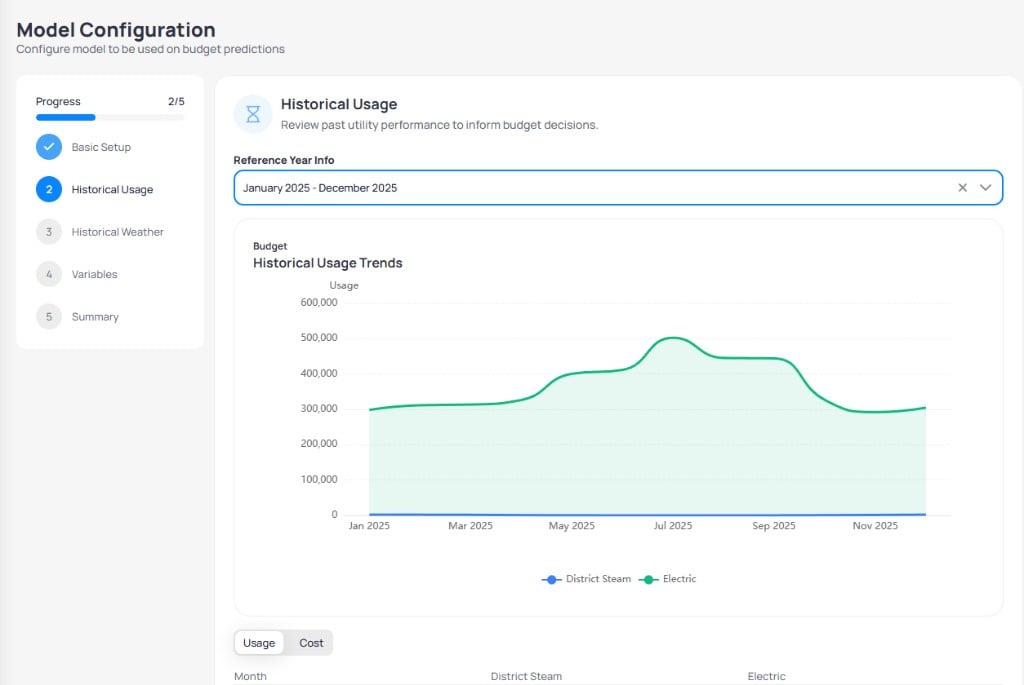
Model Configuration wizard step 2 Historical Usage with Reference Year January 2025 through December 2025 Budget Historical Usage Trends chart for Electric and District Steam and Usage Cost toggle

Model Configuration wizard step 2 Historical Usage chart

Scroll below the chart for a monthly table.
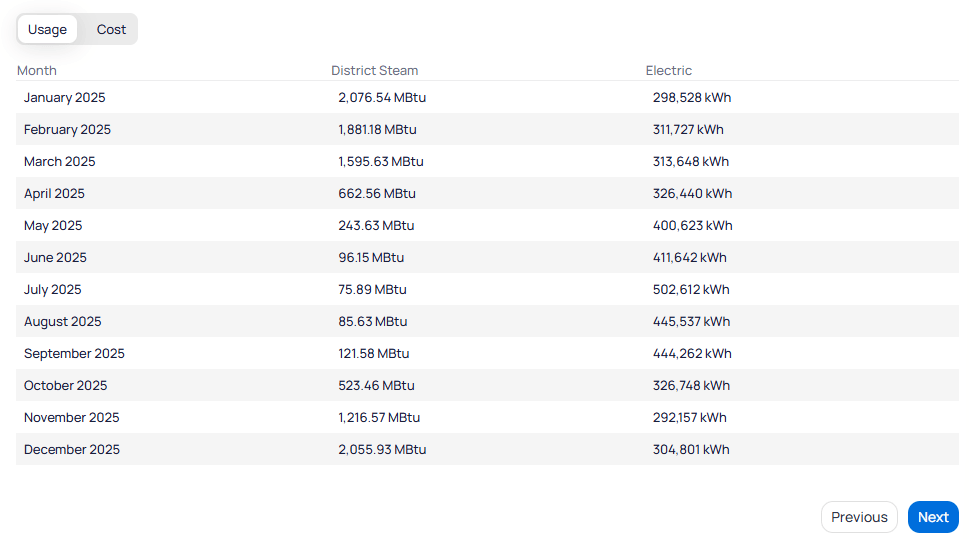
Historical Usage table with Usage selected showing Month District Steam in MBtu and Electric in kWh for each month of 2025

Historical Usage monthly table in Usage view

Confirm seasonal patterns before you click Next.

Step 3: Historical weather

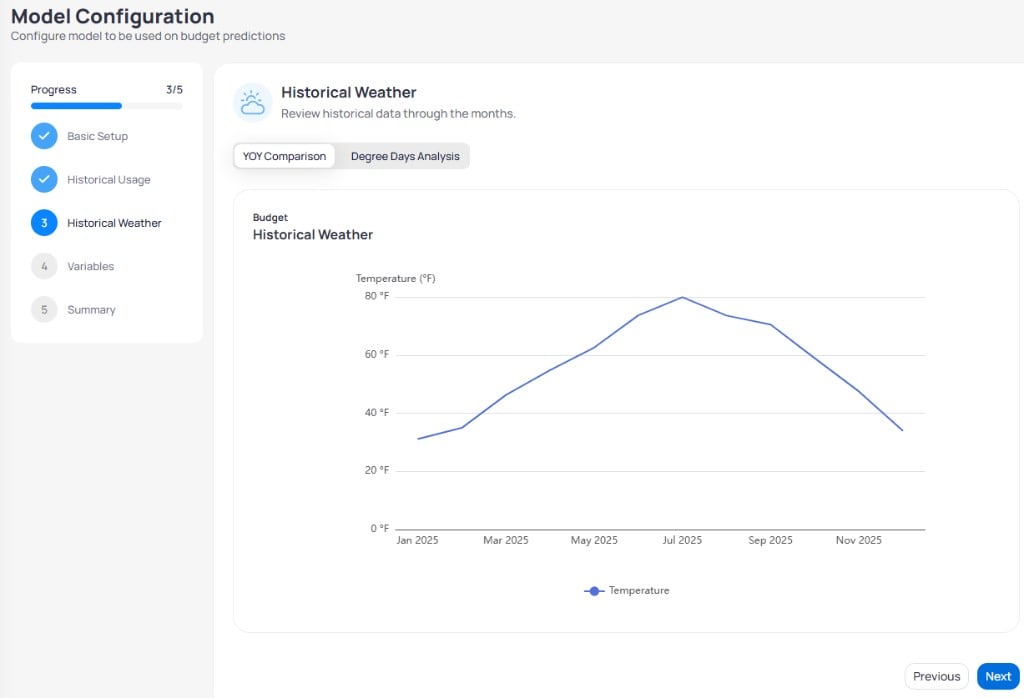
Review temperature and degree-day patterns for the reference period.

YOY comparison

Historical Weather step with YOY Comparison tab showing Budget Historical Weather temperature line chart from January through November 2025 in degrees F

Model Configuration wizard step 3 Historical Weather temperature chart

YOY Comparison plots monthly temperature for the reference year.

Degree days analysis

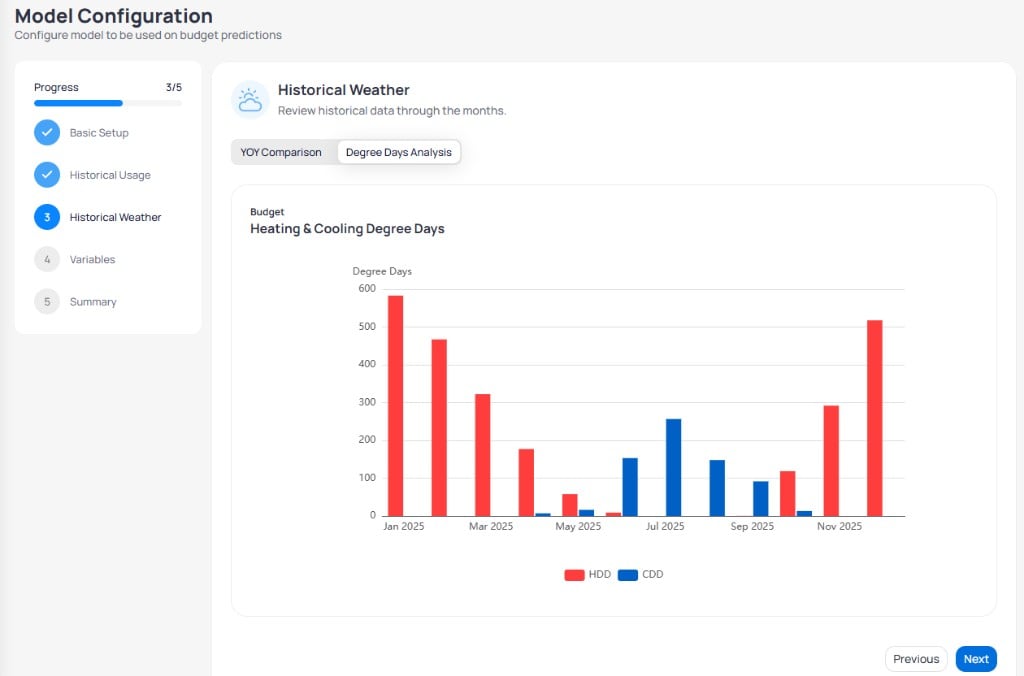
Historical Weather Degree Days Analysis tab showing Budget Heating and Cooling Degree Days bar chart with HDD red bars and CDD blue bars by month 2025

Historical Weather Heating and Cooling Degree Days chart

Degree Days Analysis shows HDD (heating degree days) and CDD (cooling degree days) by month. Use this view when Weather Normalization is a model variable. See Weather normalization for base-temperature and tolerance settings.

Step 4: Variables

Select independent variables for the linear regression model.
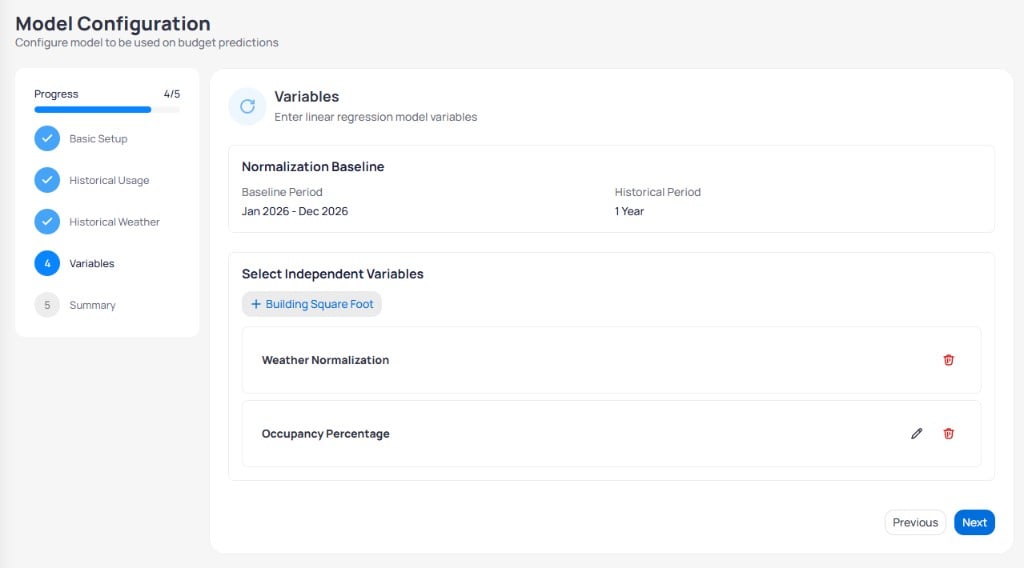
Model Configuration wizard step 4 Variables showing Normalization Baseline, Baseline Period Jan 2026 through Dec 2026 Historical Period 1 Year and independent variables Weather Normalization and Occupancy Percentage with add Building Square Foot option

Model Configuration wizard step 4 Variables

Use the pencil icon to edit a variable or the trash icon to remove one.

Step 5: Summary

Submit the configuration to train models for each service type. EnerG trains one model per service type you selected in Basic Setup.
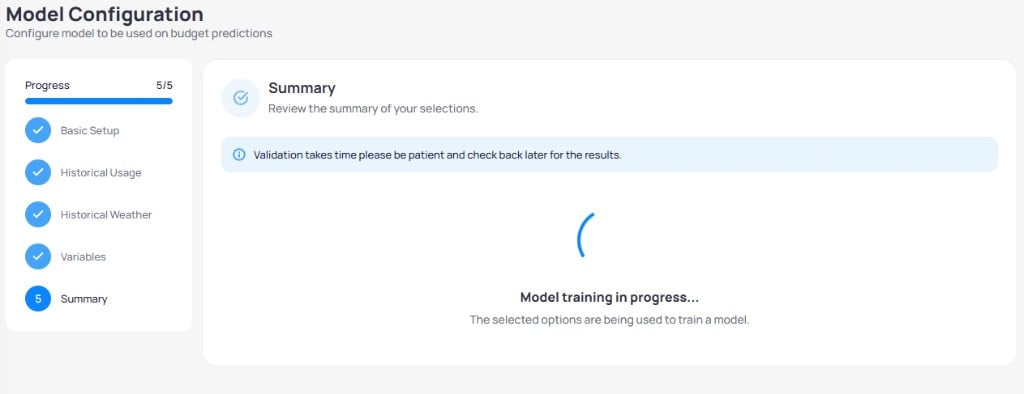
Model Configuration wizard step 5 Summary with info banner Validation takes time and spinner Model training in progress with message that selected options are being used to train a model

Model Configuration Summary with training in progress
Training runs in the background. An info banner notes that validation takes time. Refresh the wizard or reopen Summary from the configuration list when training completes.
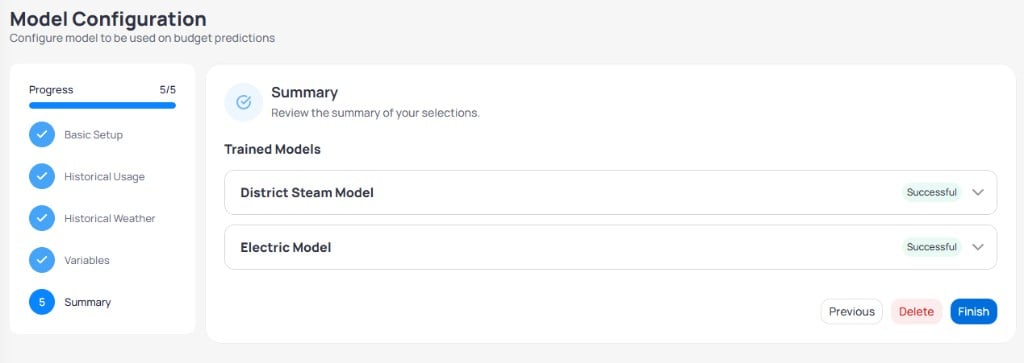
Model Configuration wizard step 5 Summary showing Trained Models District Steam Model and Electric Model each with Successful badge and Previous Delete Finish buttons

Model Configuration Summary with successful trained models

Click Finish to save the configuration. Use Delete only when you want to discard the draft before finishing. Failed models show an error state instead of Successful; widen the reference period or adjust Variables before you retry.
Do not delete a configuration that an Active budget in Budget planning still references.

Use models in Budget planning

When you create a budget in Budget planning, choose Smart Generation or Reference Year and select the trained Model from the dropdown in Basic Setup. EnerG applies predicted values from the configuration you completed here.

Next steps

Budget planning

Build Draft, Active, or Completed budgets using trained models.

Building budget overview

Compare actual spend to your active budget.

Building information

Confirm occupancy, area, and envelope inputs that affect variables.

Building meters

Verify billing completeness before you set reference periods.
Last modified on August 18, 2026