

Predicted, actual, and variance
A budget sets a planned cost for each month. As bills arrive, EnerG compares plan against reality.
Variance shows a dash until an active budget exists for the period.
Accruals
estimate cost for periods without final utility bills. They borrow prior-year shapes, apply calendarization, and close month-end gaps. Treat accruals as placeholders. EnerG trues them up when utilities post final reads. Turn accruals on for month-end reporting and off for a billed-only view during audits.Budget models
A budget model trains on a reference period to predict future consumption and cost. Three planning methods drive the values.
Smart Generation and Reference Year draw on a trained model from Model configuration. Only one budget should be active per period.
Measures, curves, and scenarios
Capital planning models conservation investments before you fund them.- A conservation measure is one project with savings, capital cost, and incentives.
- A distribution curve spreads annual savings across months, weighted by cooling, heating, or a flat profile.
- A scenario bundles measures into a funding package with priority and dates.
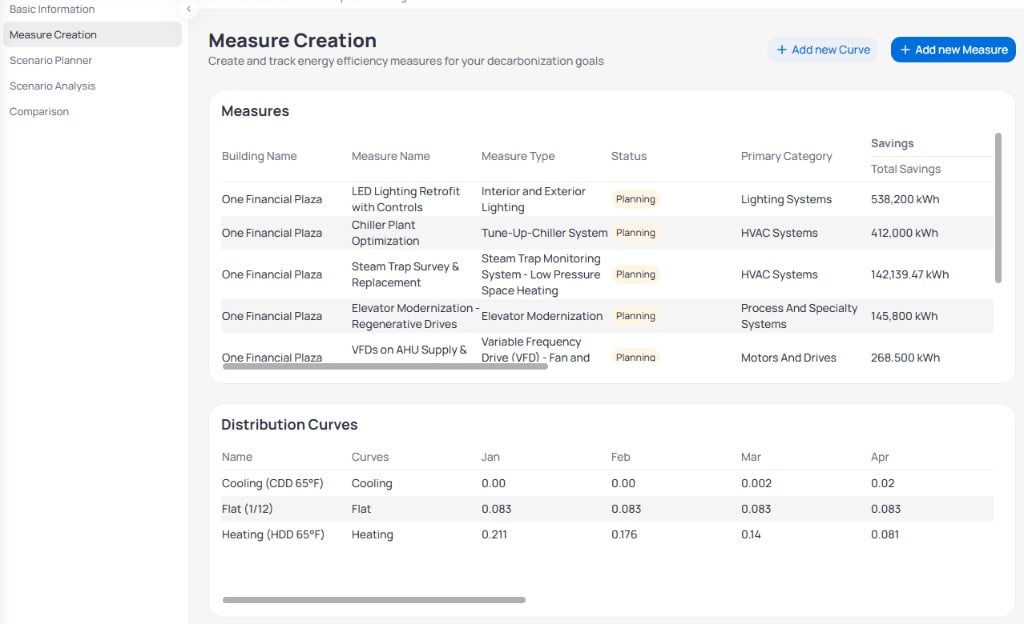
Measure creation with a measures table and distribution curves
How savings reach the budget
Measures move through a lifecycle: Planning, Implementation, then Operations. The operation date marks when savings first count. Scenarios project savings on the capital planning roadmap toward a target year. When a measure reaches operations, you connect it to an M&V model so verified savings match the plan. You also pull measures into a budget’s capital planning step so the plan reflects expected reductions.Treat simple payback as a planning signal. Confirm capital cost, incentives, and savings against your funding rules before you activate a budget.
Next steps
Budget planning
Build, review, and activate an annual building budget.
Capital planning
Create measures, curves, and scenarios for one building.
Energy modeling
See how M&V verifies the savings you plan.
Calculations and parameters
Look up distribution curves and accrual behavior.