
Templates let you save and reuse Building BI configurations across buildings and portfolios. You can template collections, dashboards, individual pages, or single charts and apply them to any compatible building.
Navigate to Building BI and select Templates at the bottom of the left navigation panel.
See template levels, templating versus deployment, and template types to choose the right reuse strategy.

Template types

Templates are organized into four categories. Use the filter buttons at the top of the page to switch between them.
The Title and Template Type fields are populated automatically when you save or import a template. You do not need to set the template type manually.
Collection templates include all contained dashboards and their data source dependencies.
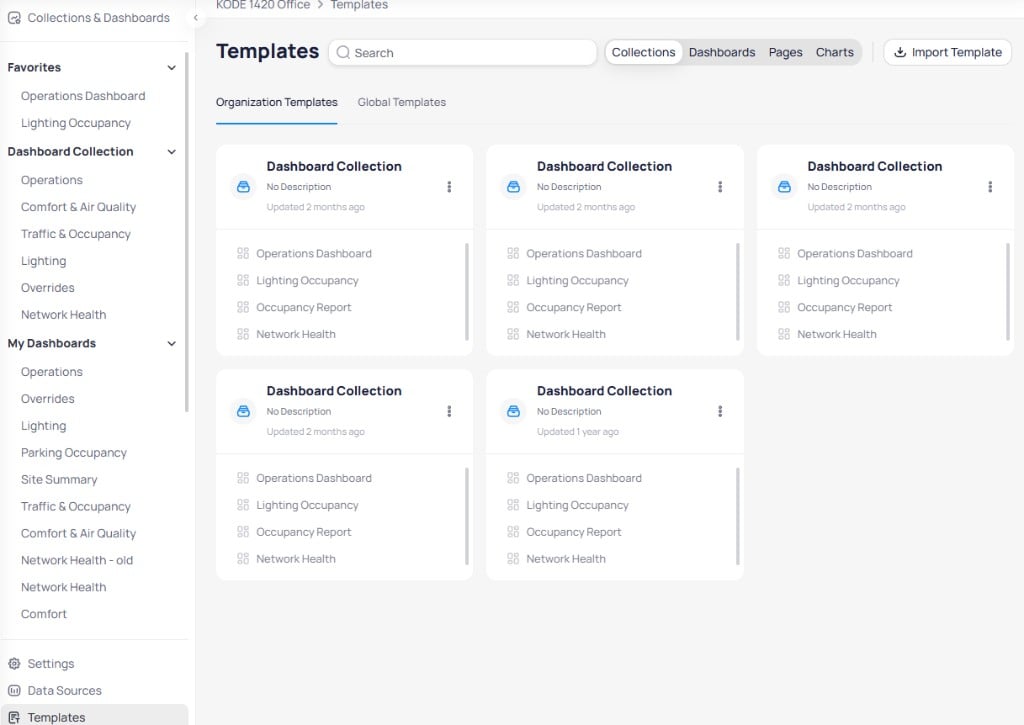
Templates page with Collections filter selected showing Organization Templates with collection template cards each listing their contained dashboards such as Operations Dashboard, Lighting Occupancy, Occupancy Report, and Network Health

Collections filter showing collection templates with their contained dashboards
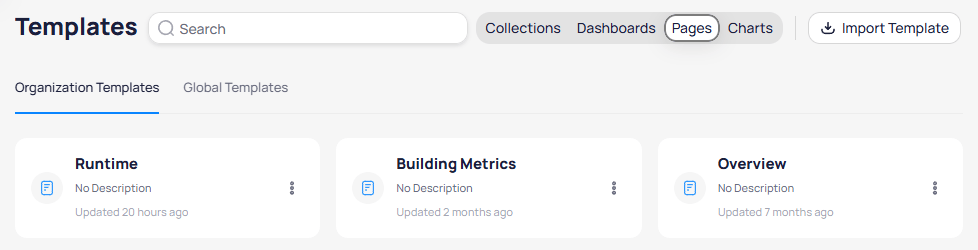
Organization templates

The Organization Templates tab displays templates created by your organization. These templates are available to all users with Building BI access in your portfolio.
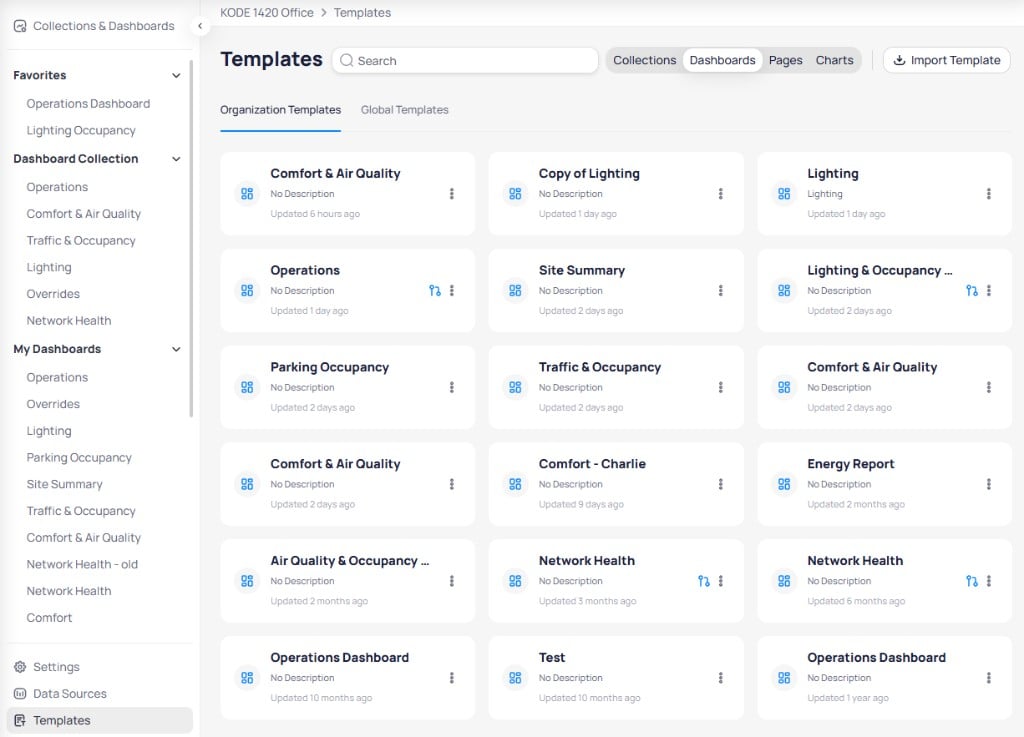
Templates page showing Organization Templates tab with Dashboards filter selected, displaying template cards for Comfort and Air Quality, Copy of Lighting, Lighting, Operations, Site Summary, Lighting and Occupancy, Parking Occupancy, Traffic and Occupancy, Comfort and Air Quality, and more with descriptions and last updated timestamps

Organization Templates showing saved dashboard templates with descriptions and timestamps

Manage a template

Select the three-dot menu on any organization template to access management actions.
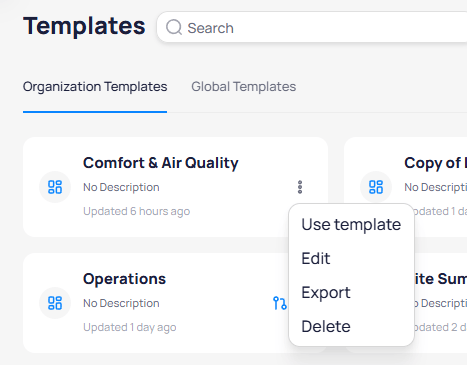
Template card three-dot menu showing Use template, Edit, Export, and Delete options for the Comfort and Air Quality template

Template three-dot menu with Use template, Edit, Export, and Delete options

Global templates

The Global Templates tab provides standard templates maintained by KODE Labs. These templates are available to all organizations and cover common use cases such as network health, operations, energy reporting, and data quality.
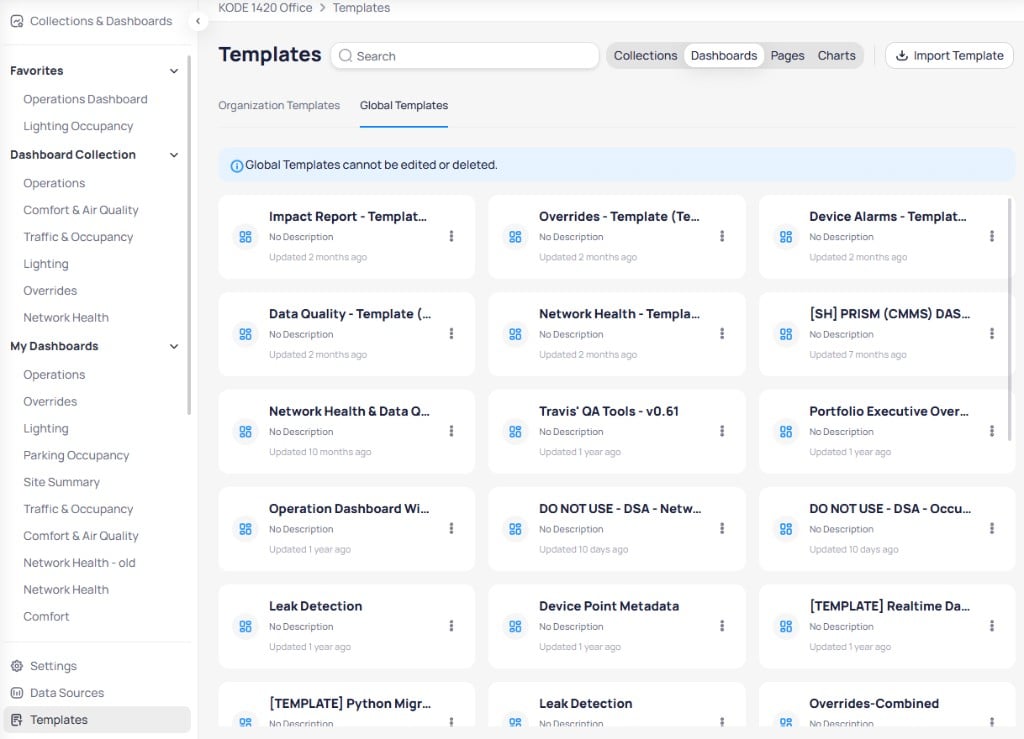
Templates page showing Global Templates tab with an info banner stating Global Templates cannot be edited or deleted, displaying template cards for Impact Report, Overrides, Device Alarms, Data Quality, Network Health, SH PRISM CMMS DAS, Network Health and Data Q, Travis QA Tools, Portfolio Executive Over, Operation Dashboard Wi, and more

Global Templates showing KODE Labs standard templates available to all organizations

Global templates cannot be edited or deleted. You can use them to create new dashboards, or export them to share the link with other portfolios.

Save as template

You can save collections and dashboards as templates directly from the Collections & Dashboards page.

Save a collection as a template

1

Open the collection menu

Navigate to Collections & Dashboards. Select the three-dot menu on a collection and choose Save As Template.
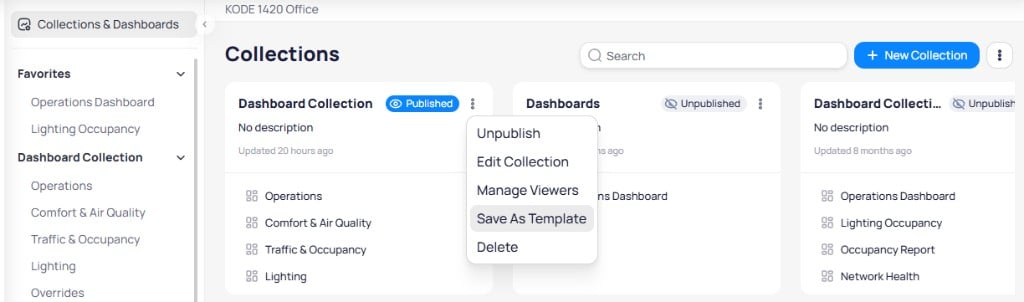
Collections page showing a published Dashboard Collection with its three-dot menu open displaying Unpublish, Edit Collection, Manage Viewers, Save As Template, and Delete options

Collection three-dot menu with the Save As Template option

2

Enter template details

Enter a Template Name and an optional Description. Select Save Now to save the template immediately, or select Next to configure dependencies.
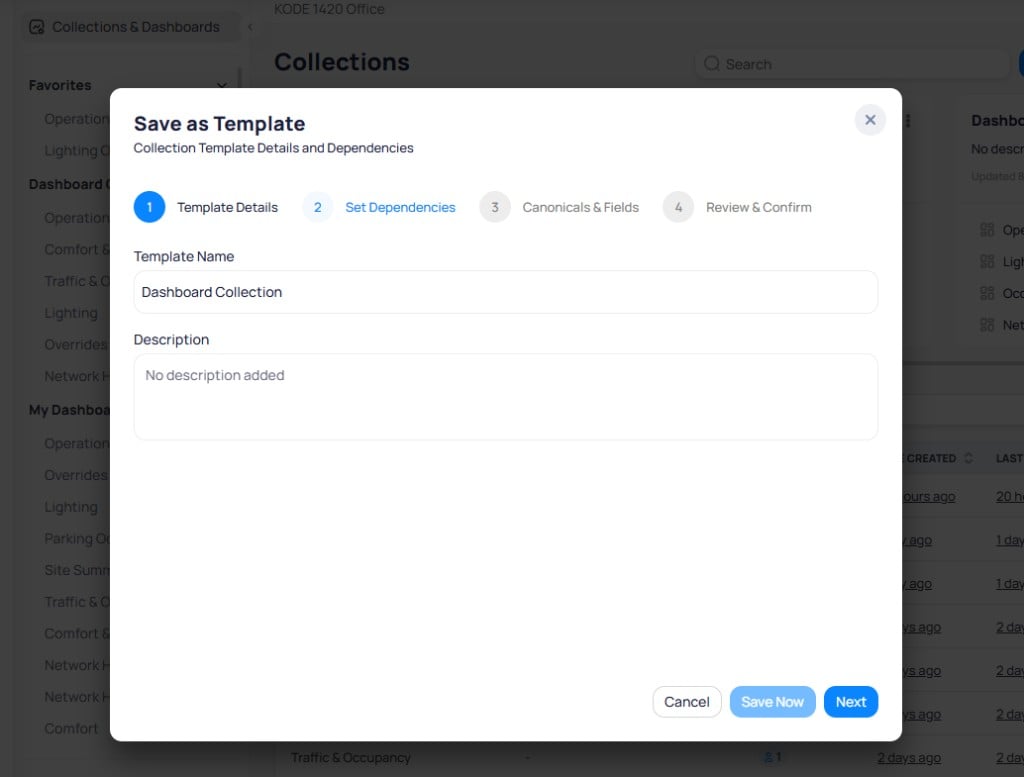
Save as Template dialog Step 1 Template Details showing a four-step wizard with Template Details, Set Dependencies, Canonicals and Fields, and Review and Confirm steps, with Template Name set to Dashboard Collection and a Description field

Step 1: Template Details with template name and description fields

3

Set dependencies

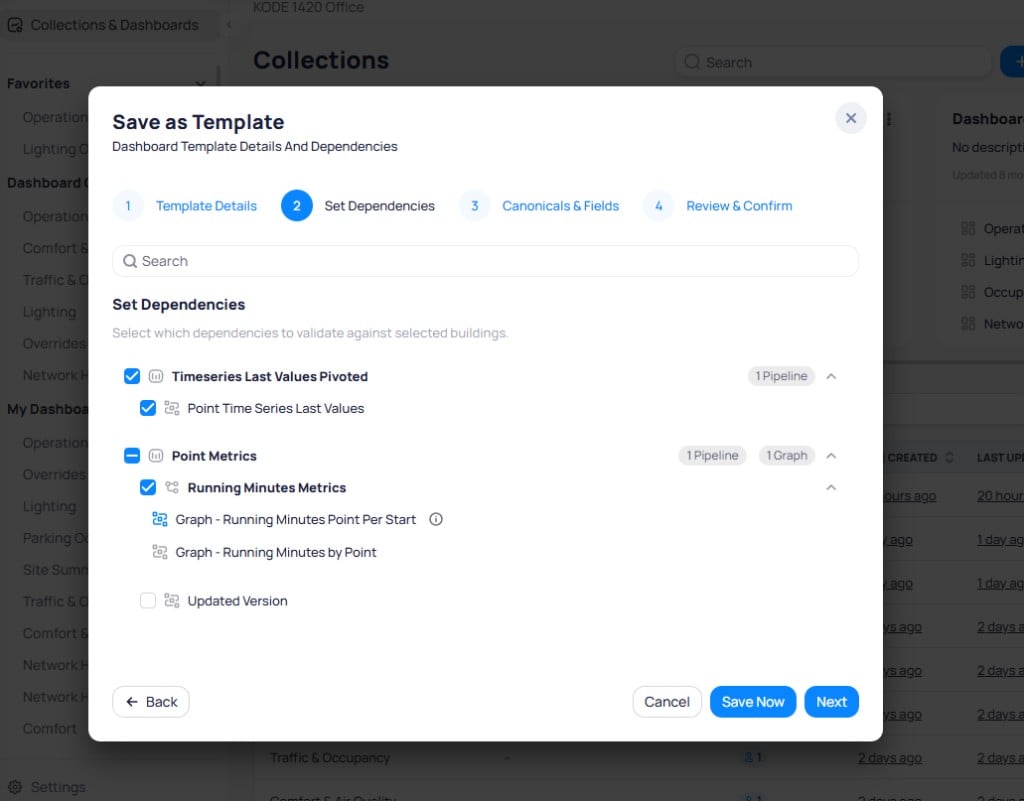
Select which data source dependencies to include with the template. Expand each data source to see its pipelines and graphs. Check or uncheck individual items to control what is bundled with the template.
Save as Template dialog Step 2 Set Dependencies showing Timeseries Last Values Pivoted with Point Time Series Last Values checked, Point Metrics with Running Minutes Metrics checked and two graph items, and an Updated Version item unchecked

Step 2: Set Dependencies showing data sources and their pipelines

4

Configure canonicals and fields

Select the canonical types and ontology fields that define how the template maps to building data. When you later deploy the template, Building BI flags any required canonical or ontology field that is missing at the target building or portfolio.
5

Review and confirm

Review the template configuration and select Save Now to finalize.

Save a dashboard as a template

Navigate to Collections & Dashboards. In the My Dashboards table, select the three-dot menu on a dashboard and choose Save as template. The same four-step wizard opens.
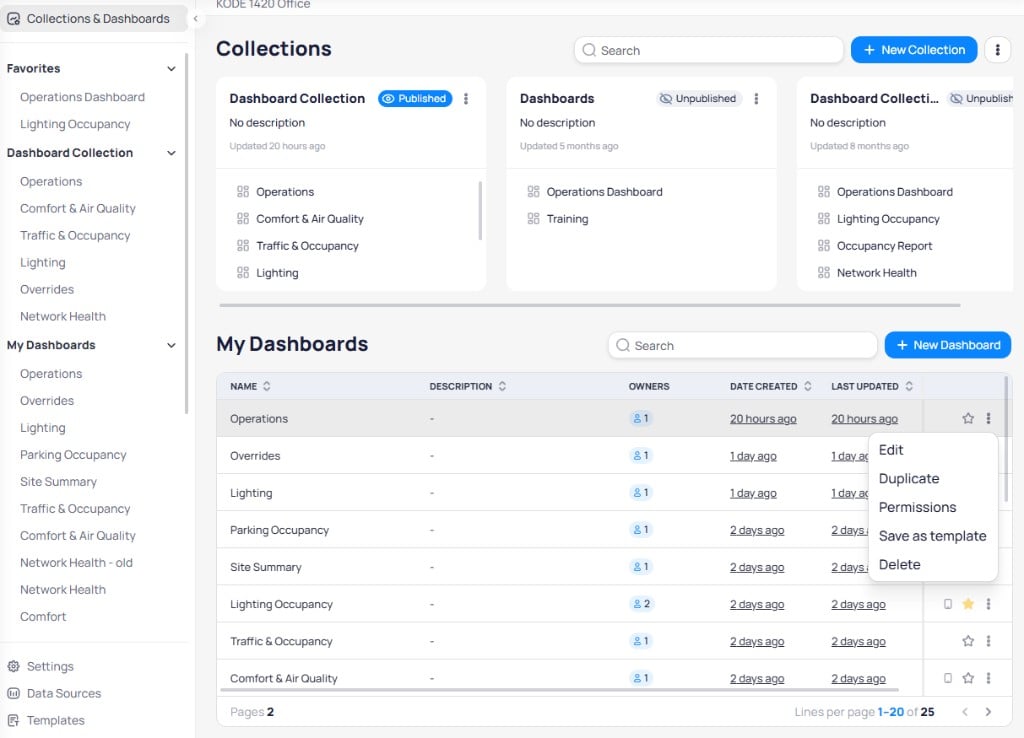
Collections and Dashboards page showing the My Dashboards table with a dashboard three-dot menu open displaying Edit, Duplicate, Permissions, Save as template, and Delete options

Dashboard three-dot menu with the Save as template option

Save a chart as a template

You can save individual charts as templates while editing a dashboard.
1

Open the chart menu

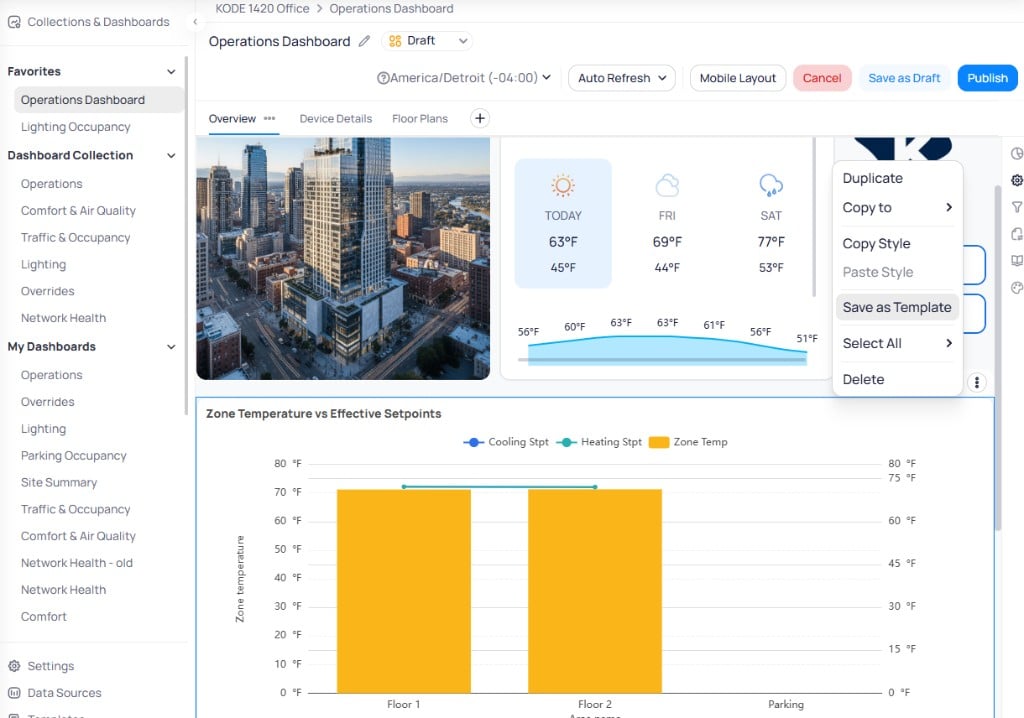
Enter edit mode on a dashboard. Select the three-dot menu on any chart widget and choose Save as Template.
Dashboard in edit mode showing a chart widget three-dot menu with Duplicate, Copy to, Copy Style, Paste Style, Save as Template, Select All, and Delete options

Chart widget three-dot menu with the Save as Template option

2

Enter template details

Enter a Template Title and an optional Description. Select Save to add the chart to your organization templates.
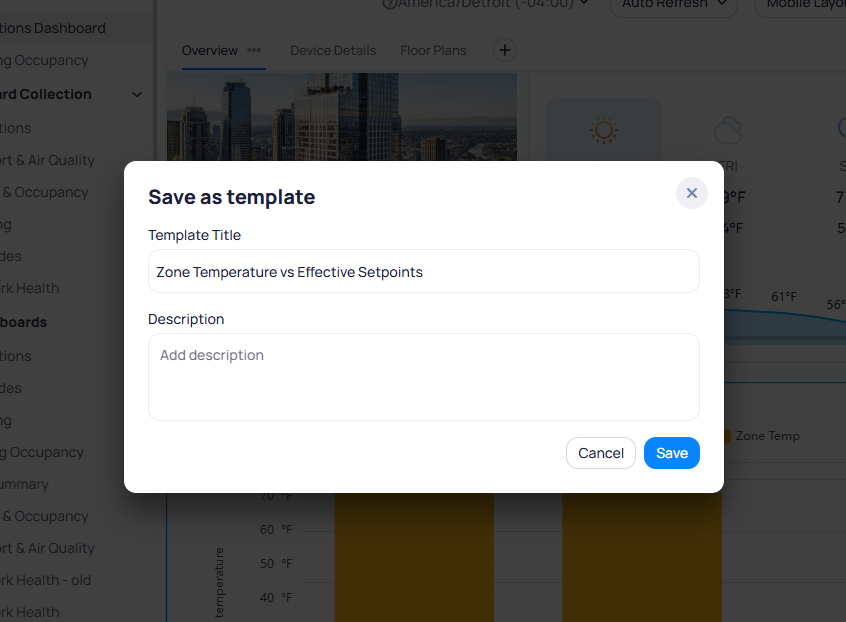
Save as template dialog showing Template Title set to Zone Temperature vs Effective Setpoints, a Description field, and Cancel and Save buttons

Save as template dialog with Template Title and Description fields

Save a page as a template

You can save individual dashboard pages (tabs) as templates while editing a dashboard.
1

Open the page menu

Enter edit mode on a dashboard. Select the three-dot menu (...) next to the page tab name and choose Save as Template.
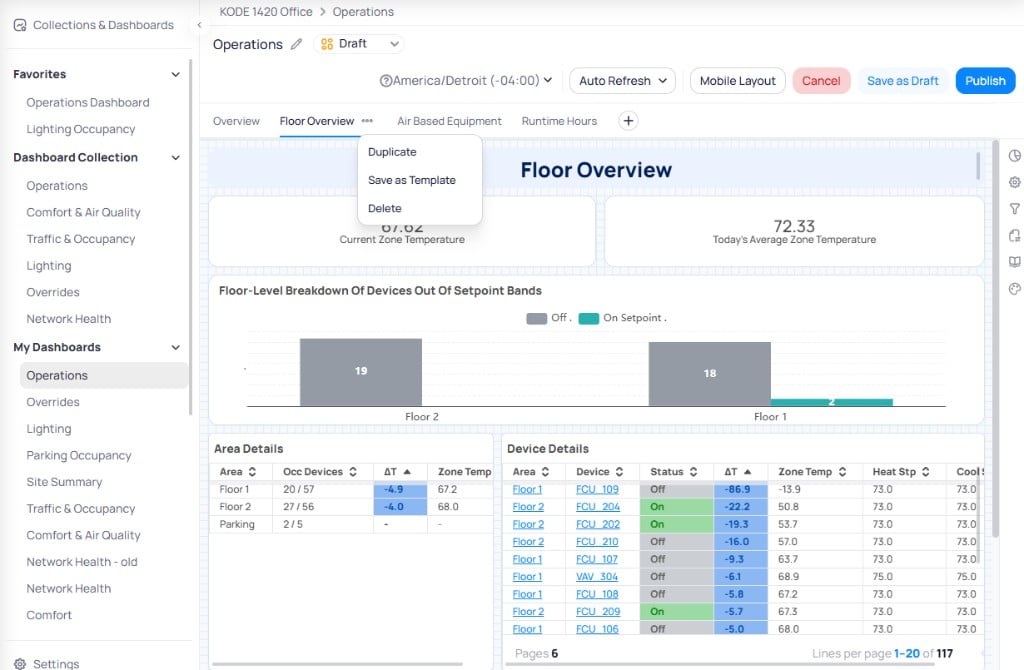
Dashboard in edit mode showing the Floor Overview page tab three-dot menu with Duplicate, Save as Template, and Delete options

Page tab three-dot menu with Duplicate, Save as Template, and Delete options

2

Enter template details

Enter a Page Name and an optional Description. Select Save to add the page to your organization templates.
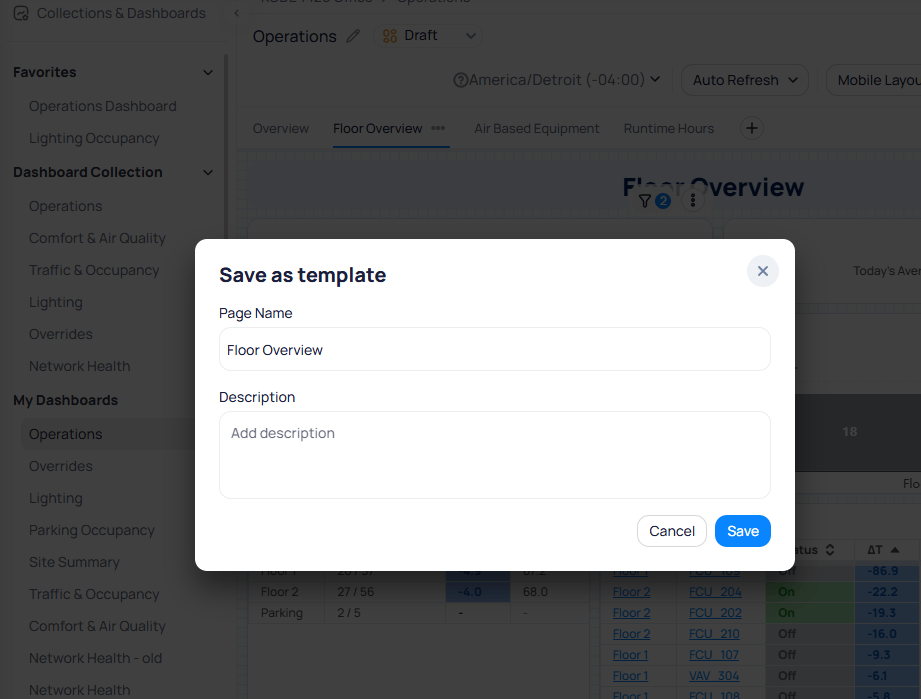
Save as template dialog showing Page Name set to Floor Overview, a Description field, and Cancel and Save buttons

Save as template dialog with Page Name and Description fields

Template Library

The Template Library is a side panel available in dashboard edit mode. It lets you add chart and page templates directly to the dashboard you are editing.
1

Open the Template Library

Enter edit mode on a dashboard. Select the Template Library button in the right sidebar.
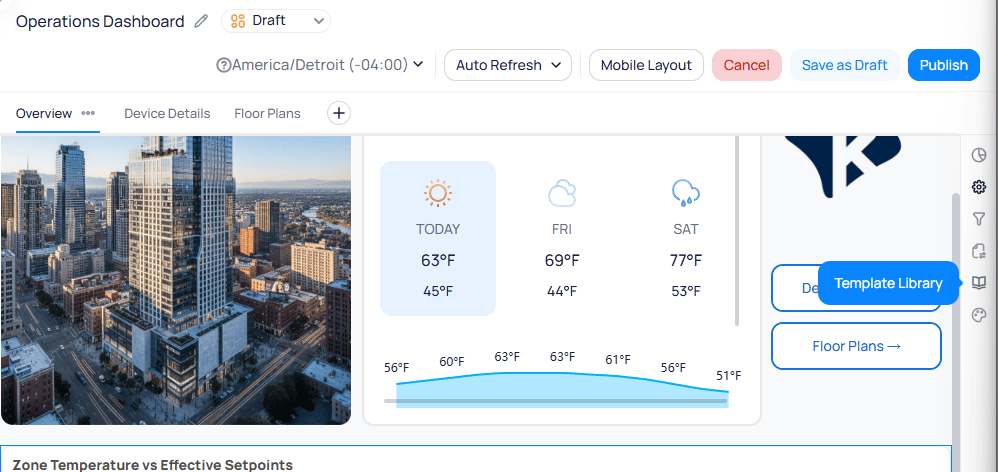
Dashboard in edit mode showing the right sidebar with the Template Library button highlighted

The Template Library button in the dashboard edit sidebar

2

Select a template type

Use the dropdown at the top of the panel to switch between Charts and Pages. Switch between the Organization Templates and Global Templates tabs, or use the search bar to find a specific template.
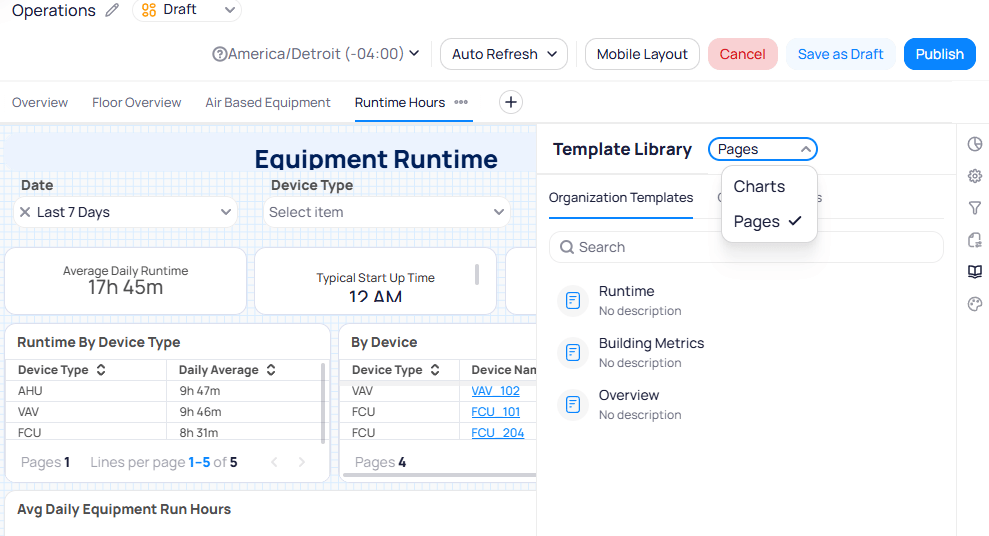
Template Library panel with the type dropdown open showing Charts and Pages options, with Pages selected and Organization Templates tab displaying Runtime, Building Metrics, and Overview page templates

Template Library type dropdown with Charts and Pages options

3

Add a chart template

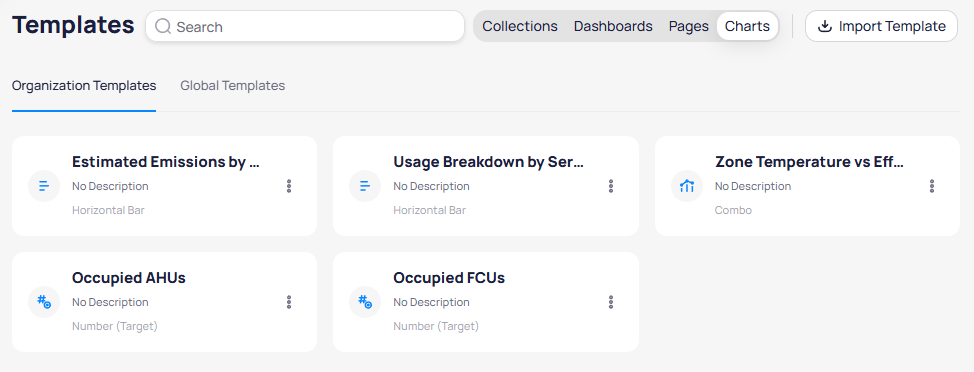
With Charts selected, drag a chart template from the library panel and drop it onto the dashboard canvas. The chart is added with its preconfigured data source, chart type, and styling.
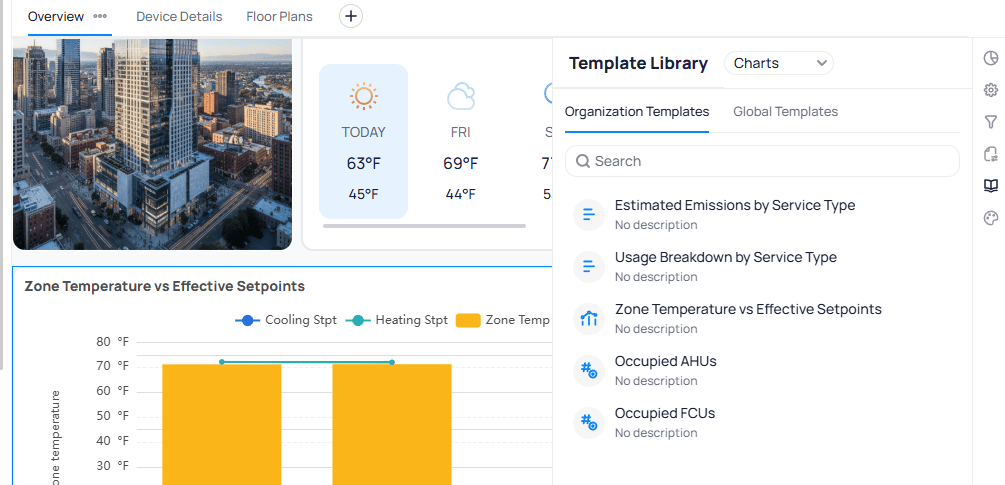
Template Library panel with Charts filter selected showing Organization Templates tab with chart templates including Estimated Emissions by Service Type, Usage Breakdown by Service Type, Zone Temperature vs Effective Setpoints, Occupied AHUs, and Occupied FCUs

Template Library panel showing available chart templates

4

Add a page template

With Pages selected, hover over a page template and select Use. The page is added as a new tab in the dashboard.
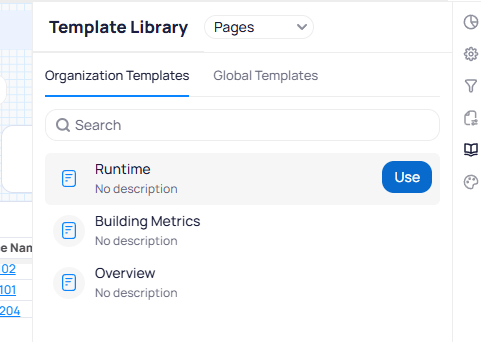
Template Library panel with Pages filter selected showing Organization Templates with Runtime, Building Metrics, and Overview page templates, with a Use button visible on the Runtime template

Template Library with Pages selected showing the Use button on a page template

Use a template

Apply a template to create a new dashboard or collection in your current building.
Deployment risk: Deployed dashboards retain the data filters, chart configurations, and settings defined on the host building’s dashboard. If the target buildings do not contain the same data, equipment, naming conventions, or configuration, some charts may return errors or no data. Before deploying, confirm that all selected buildings support the dashboard’s requirements.
1

Select the template

Select the three-dot menu on a template and choose Use template.
2

Set template details

Enter a Dashboard Name, select a Timezone, and add an optional Description. Select Use Now to create the dashboard immediately, or select Next to review dependencies.
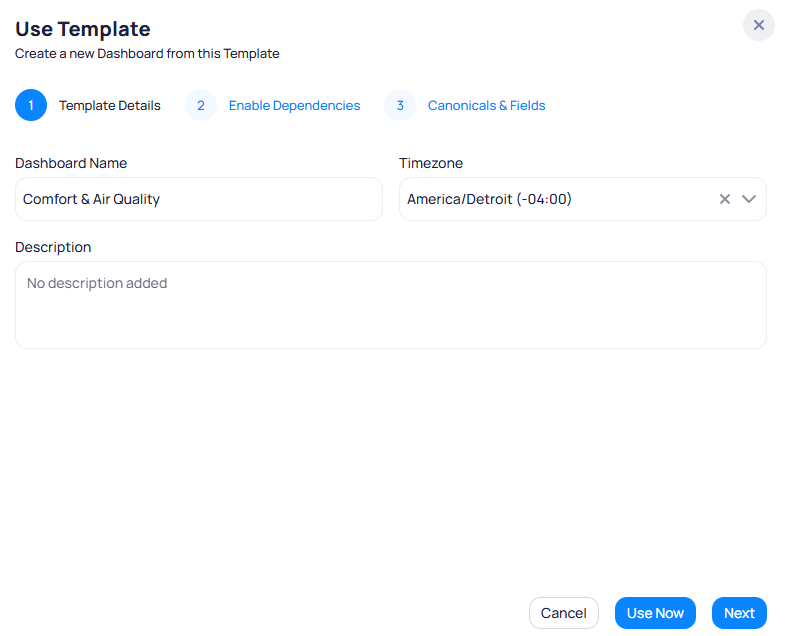
Use Template dialog Step 1 Template Details showing Dashboard Name set to Comfort and Air Quality, Timezone set to America/Detroit minus 04:00, Description field, and Cancel, Use Now, and Next buttons

Step 1: Template Details with dashboard name, timezone, and description fields

3

Enable dependencies

Review the data source dependencies required by the template. Select Enable next to each dependency to activate it for the target building. If a dependency does not exist in your organization, an info banner explains that it cannot be scheduled.
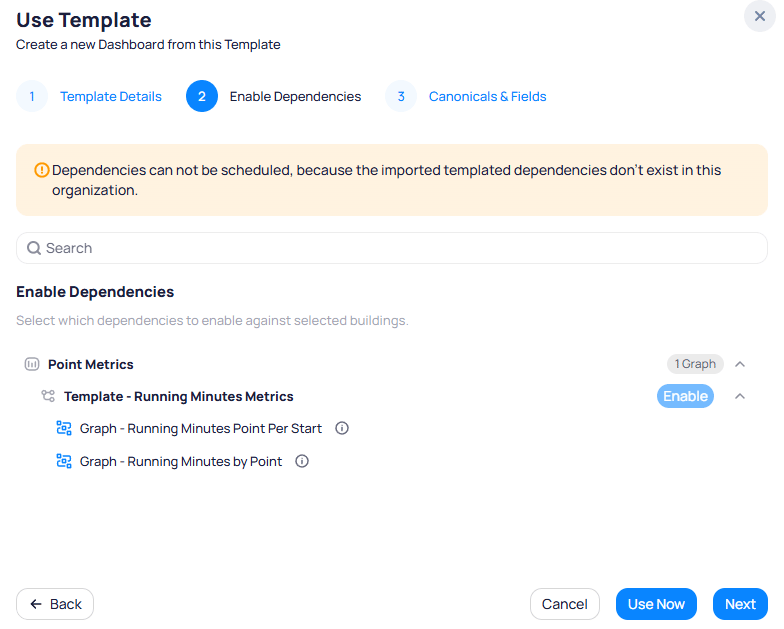
Use Template dialog Step 2 Enable Dependencies showing an info banner about imported templated dependencies not existing in this organization, Point Metrics section with Template Running Minutes Metrics and Enable button, and two graph items Graph Running Minutes Point Per Start and Graph Running Minutes by Point

Step 2: Enable Dependencies showing required data sources and their status

4

Configure canonicals and fields

Select the canonical types and ontology fields the template requires. These determine how the template maps to the target building’s data model.Building BI validates each selection against the building or portfolio you are deploying to. If a required canonical type or ontology field does not exist there, the deployment windows flags it. Use that feedback as a QA check before you finish deploying the collection or dashboard.

Export a template

Export a template to share it with another portfolio.
  1. Select the three-dot menu on a template and choose Export.
  2. The system generates a link and copies it to your clipboard.
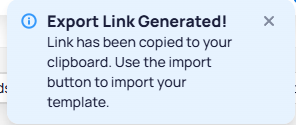
Export Link Generated notification stating Link has been copied to your clipboard and Use the import button to import your template

Export confirmation showing the link has been copied to the clipboard

Share the copied link with the recipient. They can import it using the Import Template button in their own Templates page.

Import a template

Import a template from another portfolio using an exported link.
1

Open the import dialog

Select Import Template in the upper-right corner of the Templates page.
2

Paste the template link

Paste the exported template URL into the Import URL field. The Title and Template Type fields populate automatically from the link.
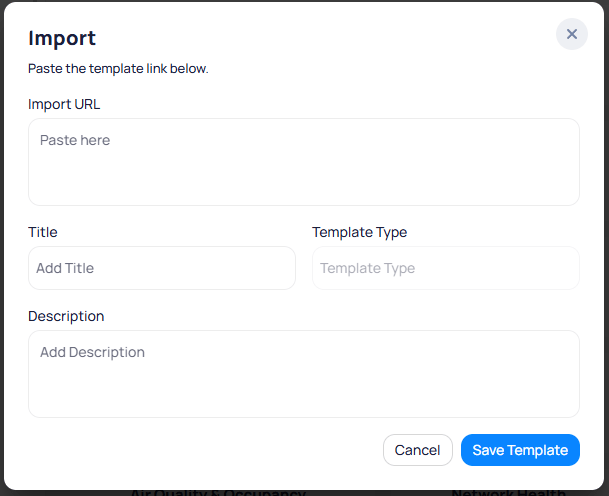
Import dialog showing Import URL field with Paste here placeholder, Title field, Template Type field populated automatically, Description field, and Cancel and Save Template buttons

The Import dialog with URL, title, type, and description fields

3

Save the template

Review the auto-populated details and select Save Template. The template appears in your Organization Templates tab.

Collections

Control visibility and organize dashboards by audience.

Templating vs deployment

Choose independent copies or governed portfolio parity.

Template types

Compare collection, dashboard, page, and chart templates.

Deployment manager

Deploy dashboards and manage predefined versus custom views.

Next steps

Collections

Organize and publish dashboard collections for your teams.

Deployment manager

Deploy dashboard configurations across multiple sites in your portfolio.
Last modified on August 18, 2026