Use this guide when you roll out FTT for operators and commissioning teams. It covers draft projects, small-scale calibration, client review, and production schedules. If you have not run a single test yet, complete What is Functional Testing? first. Confirm how scores are produced before you schedule building-wide work.

Who this guide is for

  • Building engineers and operators who will review weekly results
  • Commissioning agents who calibrate thresholds and seasonal cadence
  • Implementation teams who set the first recurring projects
Custom workflow authoring is separate. See the Workflow creator guide only when the library does not cover the sequence you need.

Standard workflows

The following workflows are the standard set for buildings with compatible equipment:

Additional workflows

Deploy these workflows as needed based on site requirements:

Choose workflows by season

Match the library page to the component you need to score. See VAV workflows, FCU workflows, AHU workflows, and Heat pump workflows.

Phase 1: create projects and check compatibility

1

Create draft projects

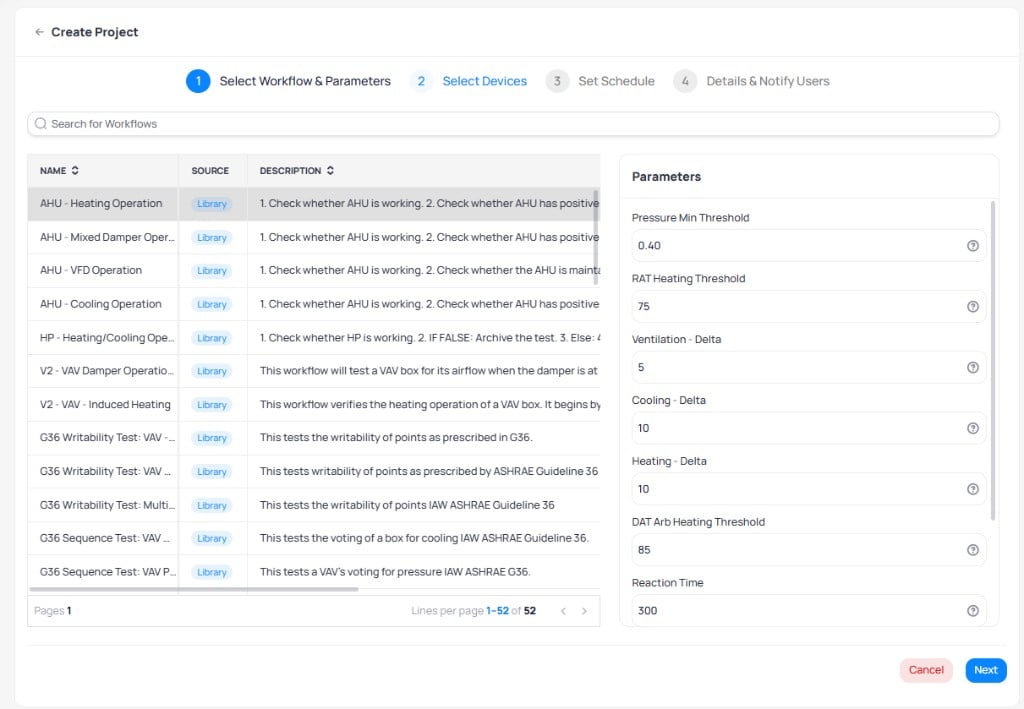
Create projects for each applicable workflow and save them as drafts. Select a workflow from the library and review its parameters before assigning devices.
Create Project step 1 showing workflow list with AHU Heating Operation, AHU Mixed Damper Operation, AHU VFD Operation, AHU Cooling Operation, HP Heating Cooling Operation, V2 VAV Damper Operation, and V2 VAV Induced Heating from Library source, with Parameters panel showing Pressure Min Threshold 0.40, RAT Heating Threshold 75, Ventilation Delta 5, Cooling Delta 10, Heating Delta 10, DAT Arb Heating Threshold 85, and Reaction Time 300

Select a workflow from the library and review its default parameters

2

Review compatibility

Review the compatibility results for each project. Devices that lack required points or writable points appear as incompatible. Address templating or write-access issues before proceeding.

Phase 2: calibrate and validate

1

Run small-scale tests

For each workflow, test five devices or one floor. The goal is to validate the following:
  • Points are writable
  • Equipment responds to commands
  • Parameters are adequately adjusted
  • At least 80% of tests pass or produce valid results
2

Tune parameters

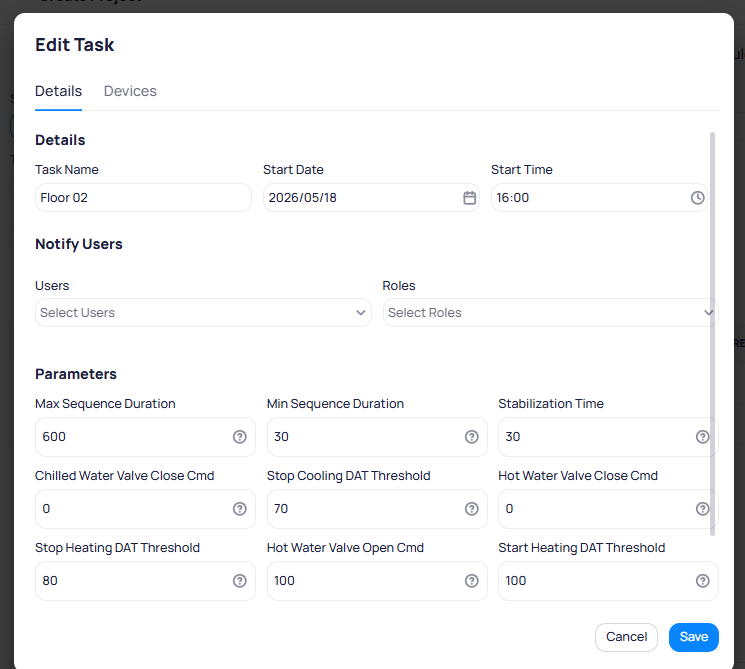
Adjust workflow parameters based on initial results. Common adjustments include increasing max sequence duration for slower equipment or modifying threshold multipliers for different equipment generations.
Edit Task dialog Details tab showing Task Name Floor 02, Start Date 2026-05-18, Start Time 16:00, Notify Users and Roles dropdowns, and Parameters section with Max Sequence Duration 600, Min Sequence Duration 30, Stabilization Time 30, Chilled Water Valve Close Cmd 0, Stop Cooling DAT Threshold 70, Hot Water Valve Close Cmd 0, Stop Heating DAT Threshold 80, Hot Water Valve Open Cmd 100, and Start Heating DAT Threshold 100

Edit individual task parameters to fine-tune thresholds for specific floors or equipment

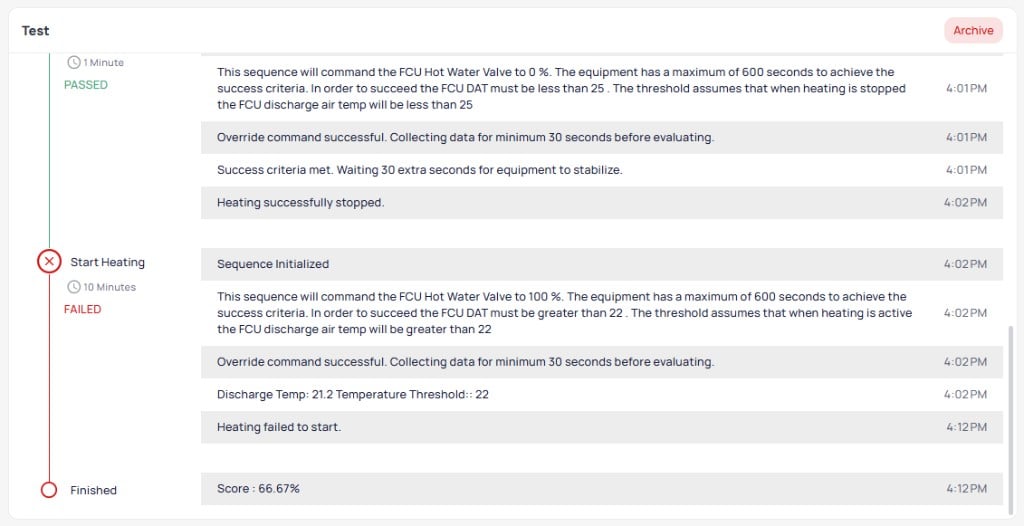
When a sequence fails, open the test report and compare the sensor reading to the threshold. See How to read a score. Retune only after you confirm the command wrote successfully.
3

Review results with the client

Present initial test results and discuss findings. The test detail report shows the step-by-step sequence with pass/fail indicators for each stage.
Test sequence showing Start Heating step FAILED after 10 minutes with Discharge Temp 21.2 versus Temperature Threshold 22, Heating failed to start, and Finished step showing final Score 66.67 percent with red indicators

A completed test result showing passed and failed sequences with a final score

Use this opportunity to confirm the testing schedule and set expectations.

Phase 3: set the testing schedule

After calibration, work with the building team to establish a production testing schedule.

Scheduling recommendations

  • Weekly testing on low-occupancy days: creates a manageable workload and cadence for operators to review results
  • Late afternoon timing: equipment runs at steady state compared to startup hours, and late afternoon minimizes occupant impact
  • Daily batches of 10 devices: takes less than 30 minutes and systematically covers the entire building over time
  • Recurring projects: set up annual or continuous testing cycles for ongoing commissioning
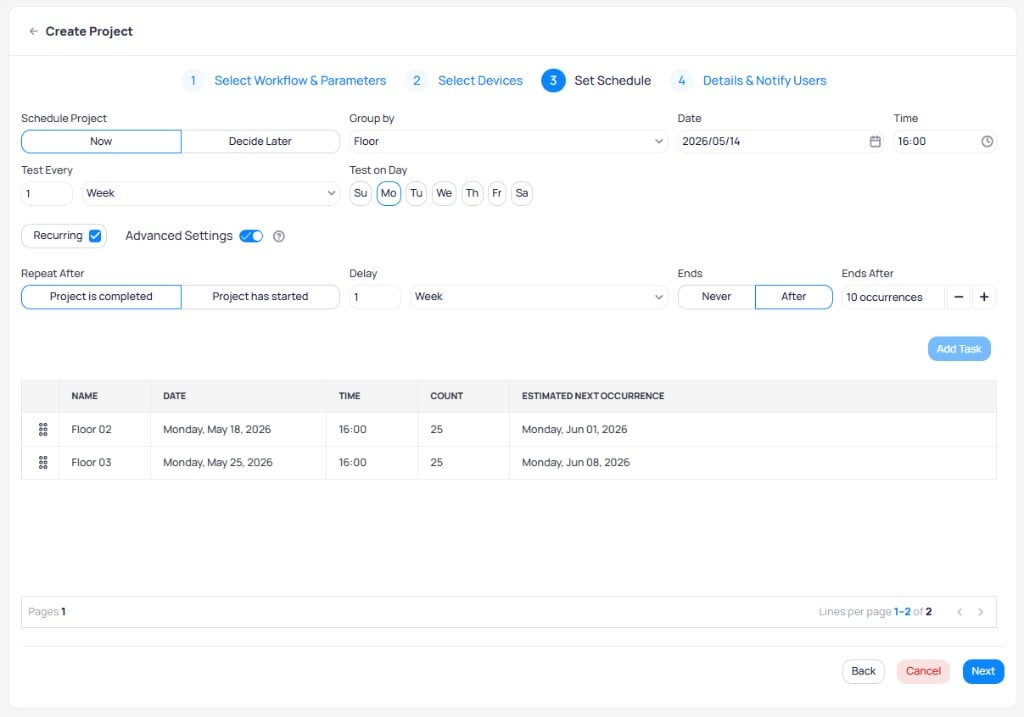
Choose floor, device-count, or single-group scheduling in the project wizard. See FTT projects for grouping guidance.
Schedule step with Recurring and Advanced Settings enabled, showing Repeat After set to Project is completed, Delay of 1 Week, Ends After 10 occurrences, and task preview with Floor 02 and Floor 03 showing Estimated Next Occurrence dates of Jun 01 and Jun 08 2026

Configure recurring schedules with advanced settings for continuous commissioning

Product support

The KODE Labs product team maintains and supports the FTT workflow library:
  • New workflow variations are added within seven days of receiving clear requirements
  • Product support is available for consulting on workflow needs
  • Review and validate workflows at the project level before escalating to product support

Next steps

FTT projects

Create and manage automated testing projects.

Test results

Read scores and investigate failed sequences after calibration runs.

Workflow creator guide

Build custom workflows when the library does not cover your sequence.

VAV workflows

Explore the VAV workflow library with parameters and success criteria.
Last modified on August 18, 2026