

Example: how FTT decides if a heater works
An heating workflow answers one question: can this unit deliver heat when commanded? The workflow runs a fixed sequence:- Check readiness — confirm the unit is occupied and the fan is running. If not, the test stops and archives. This gate is not part of the scored sequence total.
- Stop cooling — close the chilled water valve. Pass when discharge air temperature rises out of a cooled range.
- Stop heating — close the hot water valve. Pass when discharge air temperature falls out of a heated range.
- Start heating — open the hot water valve. Pass when discharge air temperature rises past the configured threshold within the time limit.
- Score the run — divide passed sequences by total scored sequences. Two of three passed is 66.67%. In KODE Library workflows, sequences are weighted equally. Custom workflows can change sequence weight when the logic exposes a weight parameter.
Why functional testing matters
Traditional commissioning requires a technician to inspect each piece of equipment and verify its operation. That process is time-consuming, expensive, and usually happens once during construction. FTT shifts this to continuous, automated testing. You schedule recurring tests across your building, catch failing equipment before occupant complaints, and keep a digital record of every result.How the pieces fit together
FTT work follows this path:- — the test logic for one equipment type and component (commands, sensors, thresholds, report text)
- — assigns devices to a workflow, groups them (by floor or count), and sets the schedule
- Task — one scheduled batch inside a project (for example, Floor 03 on Monday at 16:00)
- Test result — the step-by-step report and score for one device run
Workflows
A workflow defines the end-to-end test sequence for a specific equipment type and component. Each workflow specifies the points to read, the commands to write, the success criteria, and the text output for the report. Cloud BMS provides a pre-configured library covering common HVAC equipment:- (Variable Air Volume): damper operation, heating, airflow setpoint tracking, min/max damper
- (Fan Coil Unit): heating operation, cooling operation, fan operation
- (Air Handling Unit): heating, cooling, damper operation, operation
- Heat Pump: heating and cooling operation
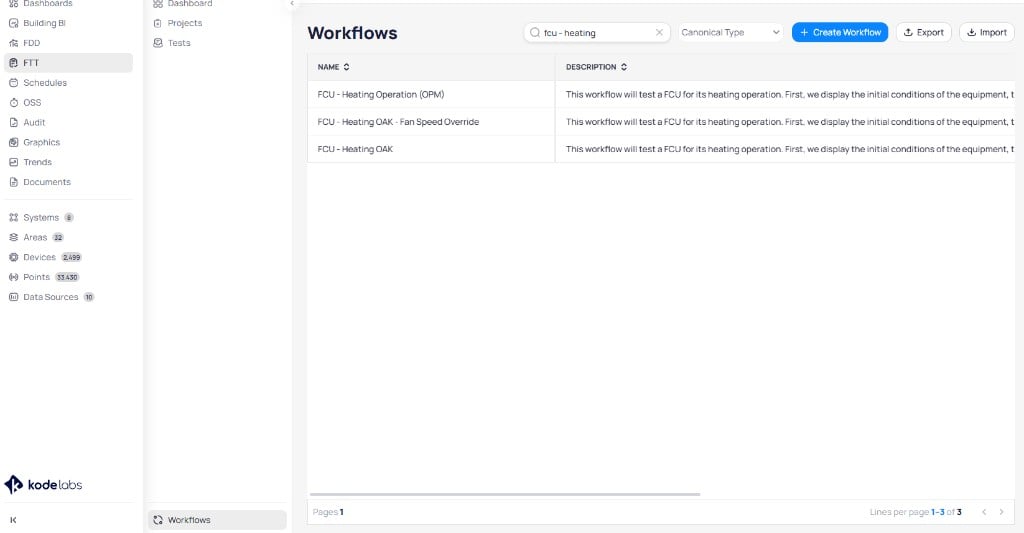
The workflows list showing available testing workflows with descriptions and device types
Projects
A project assigns one or more devices to a workflow along with a schedule. Projects can span an entire building or selected floors and run over days, weeks, or months. You configure cadence, grouping, and notification recipients when you create a project.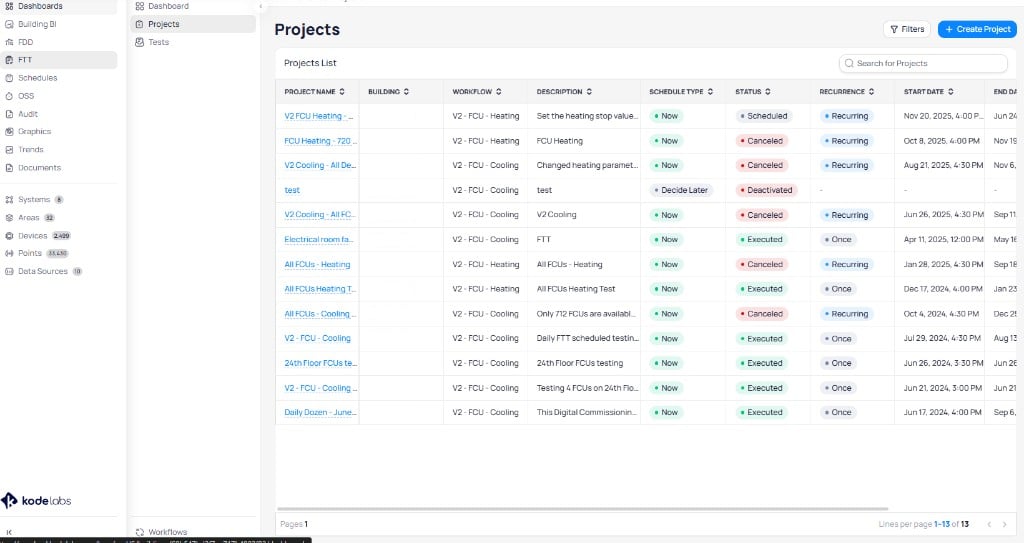
The Projects list showing scheduled and completed testing projects across a building
Test results
Each completed test produces a report. The report shows the step-by-step sequence, sensor feedback at each stage, and a pass or fail score for each component tested.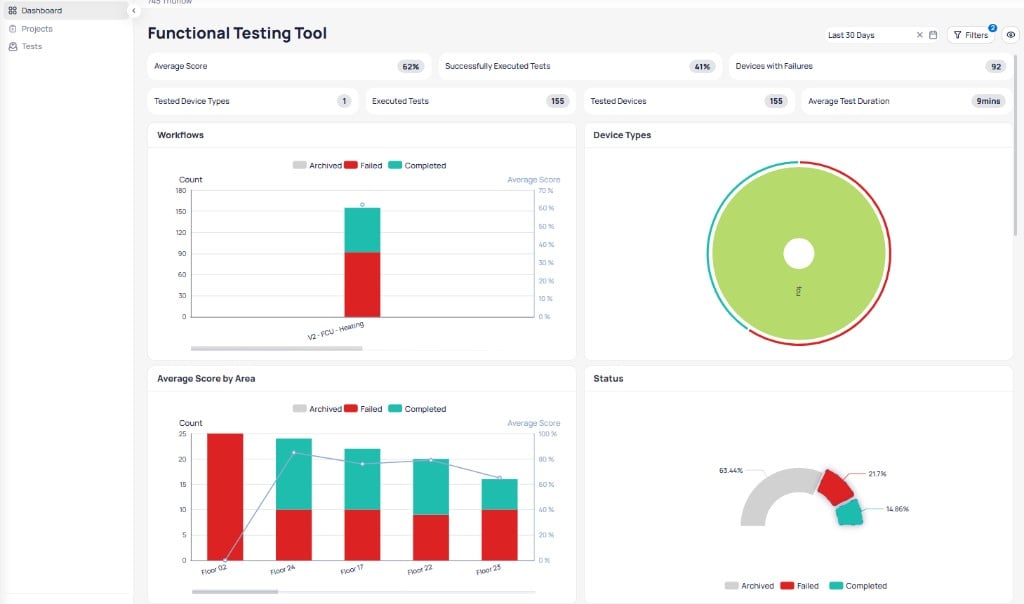
The FTT dashboard providing an at-a-glance summary of test performance
Prerequisites
FTT requires the following to produce valid results:- Correct device templating: all points required by the workflow must be available on the device
- : the test engine must be able to write commands and receive feedback
- Active equipment: the device and any parent equipment (such as an upstream AHU) must be in an appropriate operating state
Navigate to FTT
1
Open Cloud BMS
Log in to Cloud BMS and select a site from the sites list.
2
Access the FTT module
Select
FTT from the left sidebar. The module opens to the test results dashboard.Next steps
Run your first test
Run an on-demand FCU heating test and read the score.
Test results
Review test scores, detailed reports, and device test history.
FTT projects
Create and manage automated testing projects across your building.
Workflows
Browse, create, and customize testing workflows.